Showing posts with label Photo Techniques. Show all posts

Sunday, July 1, 2012

POV: Why I Like Bare Concrete Walls...


I like bare concrete walls.

Let me explain why.

Many photo tour leaders are known for setting up photographs for their groups, and it's not unusual for photographers who repeat the same photo trips with the same itinerary to end up shooting the same 'models'...albeit looking a year or two older. I've heard anecdotes of how the 'models' know exactly how to pose, which side of their face is more flattering, and know where the dotted line on model releases are.


Due to the nature of my own photo expeditions-workshops which are "event-specific" and are structured around religious or cultural rituals (the more obscure and unique the better), and because my workshops are based on the concept of "photojournalism meets travel photography", I seldom need to set up pre-arranged photo shoots as such. For one thing, the religious/cultural events that I gravitate towards during these photo expeditions-workshops are too intense, too authentic and too crowded...and consequently make set-ups unnecessary, and possibly even disrespectful.


Moreover,  the type of photographers who sign up for my photo expeditions-workshops are generally well-seasoned, experienced and are self-starters...who, not only are perfectly capable of 'de-clustering' themselves from each other, but do what good photographers do best...look for their own photo opportunities within the framework of the religious and/or cultural events.
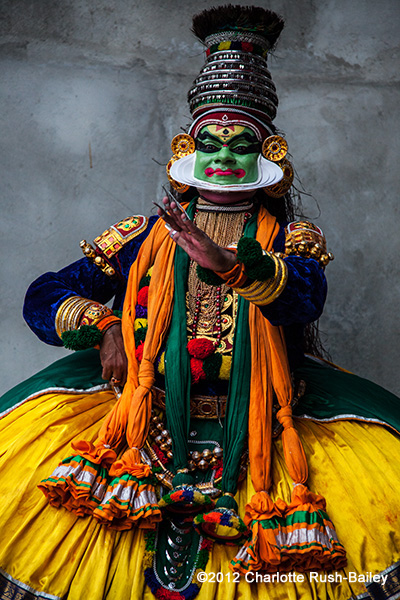


That said, there are occasions during my photo expeditions-workshops when characters are so photogenic that they figuratively jump at me, and I just have to set-up a sort of "fashion" shoot, gather the group as quickly as I can, and start the fun. However, and as much as the characters' photogenic attributes are important, the backgrounds are also as critical.


What to do if a uniquely photogenic character presents himself/herself but no appropriate background is found? I suppose carrying some form of portable background (white, black or burlap colored cloth) would solve this problem, but what if this wasn't readily available as it was during a photo shoot at a Kathakali academy on my recent The Oracles of Kerala Photo Expedition-Workshop?

We were photographing the pre-performance make-up session, and I was disappointed at the walls of the make-up area were painted a drab and blotchy kind of salmon pink, which didn't lend itself to an attractive background. However, a corner of the school was being newly built with walls of bare concrete. Bare concrete means gray and everybody knows that it helps in producing a consistent image exposure... so perfect!!!


The probability that we would all end up with the same image was my primary concern, but the light of day was perfect, the costume was perfect, the dancer was image-savvy and the performance was about to start. So we were shooting paparazzi-style for a few minutes...and despite the appearance of what photojournalists (and the military) describe as a "clusterfuck", we were all happy with the opportunity.

I asked the participants of The Oracles of Kerala Photo Expedition-Workshop to send me their favorite(s) photograph from that shoot without telling them why...imagining that their photographs would be identical. They're not. Because of their experience, their difference in shooting styles and because of the dancer's adopting various poses, the results of that particular "clusterfuck" were satisfactory.

So much so that I've used my own image of the shoot for the background of my website.

That's why I like bare concrete walls...and so should you.

Monday, May 7, 2012

The Travel Photographer's Warm Split Tone LR Preset


Photos © Tewfic El-Sawy-All Rights Reserved


I've received a number of emails asking me how the toning of the still photographs of The Spice People of Mattencherry audio slideshow was done.

It's an overly saturated look, which I thought would go well with the color of turmeric, ginger and the burlap sacks so prevalent in that ancient area of Kochi. So here's the "secret sauce" as some call this sort of post processing workflow, which in reality is really quite simple.

It obviously is not suited for many types of photographs and projects, but if you need this sort of saturation, do try it and see if it suits you. For fine tuning, I'd increase or decrease the Blacks slider as deemed necessary after choosing the preset.

To download, click on The Travel Photographer's LR Presets.

Tuesday, February 14, 2012

Maika Elan: Thaipusam Festival

Photo © Maika Elan-All Rights Reserved

Photo © Maika Elan-All Rights Reserved

I really can't describe Maika Elan's recent photography style with certitude, and don't know if it really fits neatly in a category...but what I do know is that it's ingeniously creative.

First off, Maika's birth name is Nguyen Thanh Hai, and is a freelance photographer from Hanoi. Her photography was recognized with a number of awards, and she's currently working hard on completing her long term project...The Pink Choice, in which she documents gay life in Vietnam and elsewhere.

Maika attended the Thaipusam festival held at the Batu Caves, near Kuala Lumpur in Malaysia, and decided that, rather than documenting this festival in a traditional editorial style, she would try to fuse the festival's ancient rituals and tradition with modern images of Western culture. She did so by photographing popular culture magazines, and then double exposed these with her images made during the Thaipusam festival.

The result is an intriguing collection of images which, if you peer at them closely enough, will reveal faint images of Western models superimposed on Maika's photographs of Thaipusam scenes.

You may prefer to view her gallery on Invisible Photographer Asia.

When I heard she was on her way to photograph the festival, I was certain she'd come up with an unorthodox way of documenting it her way...a la Maika. Yes, that's what I ought to call her style...the Maika style.

Thursday, January 5, 2012

POV: Street Photography In Old Delhi

The Quizzical Guy. Photo © Tewfic El-Sawy-All Rights Reserved

The Coco Seller. Photo © Tewfic El-Sawy-All Rights Reserved

The Don't Photograph Guy. Photo © Tewfic El-Sawy-All Rights Reserved
Old Delhi is one of my favorite locations for street photography, and is a must stop for me when I'm in India for my photo expeditions/workshops.

I produced a short documentary audio slideshow on the Spice Porters of Khari Baoli of Old Delhi, but on my way through Chandni Chowk, I started photographing with my M9. While some of my photographs were made by shooting from the hip, most were not. Chandni Chowk, as any other market and public place in India, is a dream environment for street photography since it teems with living tableaus.

Notwithstanding, most photographers are bound to be noticed and stared at. Now, this is a problem because the essence of street photography, as told to me many years ago by Costa Manos, is that no one must see the photographer. In other words, if any subject in one's street picture is seen looking at the camera, the photographer has "failed" in capturing the moment. Perhaps extreme, and very difficult to achieve in India where people are alert, curious and have no problem at dropping what they're doing to stare at whatever and whoever interest them.

It takes a little more speed, sometimes stealth, and certainly patience to work around this. We all have our techniques, but I find that a lot patience and "fading in the background" works best. Eventually, the most curious loses interest and I have free rein in photographing as much as I care and need to.

Here are some examples of the street photography "obstacles" I faced during my latest trip in Chandni Chowk.

The top photograph is of someone I describe as "The Quizzical Guy". He saw me photographing, and just froze alongside some mannequins, and kept staring at me for a while...trying to figure out what I was doing. So I photographed him.

The middle photograph is of someone who's the exact opposite of The Quizzical Guy. He probably saw me photographing The Coco Seller, but didn't care and just walked through. If he didn't notice me, he's probably a rarity amongst the crowds of Chandni Chowk.

The bottom photograph is of the "Don't Photograph" fellow. The man had absolutely nothing to do with Khari Baoli, but thought he had authority of telling me not to photograph. I get this type of people quite often...and I tell them quite firmly they ought to move on and find something better to do. He must have been a retired police officer who missed his authority. He wagged his finger at me, and quickly left.

Wednesday, September 14, 2011

Yatin Patel: Sutra


I'm pleased to have been directed to Yatin Patel's website whose title Sutra in ancient Sanskrit translates as "a thread or line that holds elements together".

Yatin Patel is an Orlando-based photographer, internet entrepreneur and native of India, and his "Sutra" project consists of images of Ahmedabad, the largest city in Gujarat. The project uses high dynamic range (HDR) imaging, which gives photographs a distinct artistic feel.

As explained in Yatin's Wikipedia entry, he chose Ahmedabad as subject because it's a partitioned city, with ancient gated communities, small enclaves of different cultures, and lots of hidden courtyards.

Some of the "Sutra" series of prints have been printed on Japanese kozo (rice) paper, and the process is explained in a number of posts on Yatin's blog. The combination of monochrome HDR imaging and rice paper is an interesting one; the photographic style is certainly one of street photography, processed with HDR techniques and then printed on a textured medium.

The choice of Ahmedabad is an excellent one. Founded in 1411 by Sultan Ahmed Shah, its architecture is a fusion of Hindu craftsmanship with Islamic architecture. I would think that Yatin will eventually do the same in Varanasi and Old Delhi, to name but two similarly compelling cities.

My thanks to Ron Mayhew, an accomplished photographer himself, who suggested Sutra to me.

Thursday, June 9, 2011

The Dancer & Name Branding

Photo © Tewfic El-Sawy-All Rights Reserved

As I've posted a few days ago, I've been fiddling with the trial version of Flare, an app that describes itself as "a fast, easy, and beautiful darkroom for your desktop".

With Flare, one can apply interesting photographic effects to photographs, and it comes with more than 20 presets. It's a matter of drag and drop...mere seconds to get the preset look one likes. The above photograph (click to enlarge) of a traditional dancer I made in Bali last year got a Flare preset treatment, which includes a grungy border.

In all candor, I am beginning to like Flare a lot. I also happen to be a fan of Lightroom's presets...and a fan of anything that reduces the time I spend in post processing images to a minimum. And if this 'anything' is simple enough for a 2 year old to master, it's a hit as far I'm concerned.

In any event, it's fun to be able to use applications such as Flare and others, accepting that these degrade the quality of the images.

But wait, didn't I title this post to include Name Branding? This is important...If you ask any marketer how to set yourself apart from the rest, they’ll all tell you to the same thing, establish and secure your brand.
"I now have a lock on The Travel Photographer as a brand name on most popular blogs...this includes my domain brand name, my Twitter account and my Facebook page."
Keep reading and you'll see what I mean. For a couple of more examples of my photographs fiddled about with the Flare app, drop by The Travel Photographer on Tumblr. Yes, I have various blog platforms such as Posterous, Wordpress and Tumblr with The Travel Photographer brand name....and here's some useful advice: if you have a brand name (your name can be a brand name), you ought to do the same. I now have a lock on The Travel Photographer as a brand name on most popular blogs...this includes my domain brand name, my Twitter account and my Facebook page...and I'm keeping an eye out for any new ones.

As a footnote: I have no relationship whatsoever with Flare. It's just a fun application.

Saturday, July 12, 2008

Rick Sammon & On-Location Portraits

Photograph © Rick Sammon-All Rights Reserved

Rick Sammon is a prolific travel photographer, author and instructor who has just written an interesting article in Layers magazine titled The Art of the On-Location Portraits.

This sentence caught my eye: "For me, the key to getting a good on-location portrait is to fall in love—photographically—with the subject. That’s exactly what I did when I saw this young woman. Out of the 50 or so people who lived in this particular village, she caught my eye immediately.

I couldn't agree more. The key to a good portrait (in fact, I'd argue it's the same whether on location or in a studio) is to establish a rapport with your subject. I've posted about this very thing in June last year in a post titled POV: Better Travel Photography . The foundation of successful environmental portraiture and ethnographic photography is the establishment of a relationship between the photographer and subjects....it's a no-brainer. When I lead my photo tours, I always sound like a broken record, and the mantra is "connect with your subject(s)...befriend them and start a conversation". Not only will the photographers make much better photographs, but they'll have background stories to go along with them. You'll be surprised at how long these memories stay with you.

So yes, absolutely...do what Rick Sammon says, fall in love photographically with your subject!!!

Via David duChemin's excellent Pixelated Image blog

Friday, December 28, 2007

Photo Submissions: Elementary Tips

Image © Tewfic El-Sawy-All Rights Reserved

A large adventure travel operator has recently requested photo submissions for its annual catalog from its approved photographers, and I thought I'd share with you how I'll go about presenting my submission.

Firstly, the client wants the initial photo submissions in low to medium resolution saved as jpgs. Once the choice has been done, submissions are to be in TIFF or PSD formats at high resolutions scans of 300 dpi. All this is pretty much standard for all photo submissions of this type.

Once I've decided on my photographs, I label each digital image with my name and an ID number. I burn these images on a DVD (or a CD for the initial submission) having grouped them in geographically-named folders (ie Bhutan, Ethiopia, etc). I also prepare a page with thumbnails of the submitted photos and burn that on the DVD or CD, along with a cover letter to the client with my address, and contact details. This too is pretty much standard.

I always use printable media (DVD or CD) and with my inkjet printer get them labeled with my name, copyright notice and client's name. I prefer DVD cases such as the one on the left, which provide more protection and are better looking than the square plastic ones. I print another sheet with the thumbnails, add my name, address, contact on the bottom and insert that in the front of the DVD case.

It presents well, and while it won't necessarily make my images stand out from the competition (I'm sure many photographers do the same or have similar ideas), it looks neat and professional. The days of scribbling on the CD and popping it in a mailer are gone!

Thursday, November 8, 2007

Is Travel Photography Dying...or Dead?

Image Copyright © Tewfic El-Sawy-All Rights Reserved

A few days ago Heather Jacobsen of hk imagery and a reader of TTP, asked me whether I thought that travel photography was dead...she had heard that statement from many in the industry, and was interested to know my view.

Well, here it is: I do not subscribe to the notion that “travel” photography is dead. It has evolved...and I mean really evolved...not a progressive kind of evolution, but it changed with a relative abruptness that left many of those unprepared gasping for air...and not only was the change sudden, but it happened dynamically.

The confluence of many factors contributed to the evolution of “travel” photography. The relatively cheap travel, the accessibility of the ‘off-the-beaten path’ places, computers, digital photography and all its hardware and software accouterments, the Internet, mini-stock agencies and free photo hosting websites, to name but a few, are all factors that changed traditional ‘travel’ photography industry.

So my response to Heather was essentially that traditional "travel" photography had evolved so much and so rapidly, that many deemed it dead. I guess the emphasis here is on 'traditional'. I also made the rather obvious point that photographers needed to acquire new skills to adapt in this new environment.

Everyone realizes that anyone with a half-decent digital camera can now produce sensational photographs of the Pyramids or Angkor Wat, but that doesn’t mean that working photographers should give up and stay home doing something else. It just means (at least to me) that photographers who travel to photograph must develop skills and abilities more akin to those of photojournalists...they need to tell stories with their photographs.

I follow the Travel section of the New York Times quite closely, and see how photographers and its photo editors are using its website to effectively showcase travel photography. I recently posted a multimedia feature (by Chris Ramirez) on Trinidad which combined photography with its food and wine industry: one of a rapidly expanding genre in the travel photography domain.

There are photographers at the top of the food chain...the members of the ‘oligopoly’… who still sell technically perfect photographs of the Pyramids, or of infinity swimming pools in the Maldives, or of coconut trees swaying in the wind...and who get handsomely paid...but even they are a dying breed and their days are numbered.

While I'm at it, let me add this about the photo tours business...and I've been saying it for years. Photographers -whether celebrity or not- who lead photo tours can no longer rest on their laurels. They too have to evolve. The days of doing the same itinerary over and over are gone...and the "hey! shoot like me!" days are also gone. Photo tour leaders have to research and offer, not only new itineraries, but guidance as to how to weave the participants' daily inventory of photographs into eventual photo stories....how to build compelling stories out of their photographs. Yes, that's right...more workshop-like than just a photo tour.

I firmly believe that the future of "travel" photography is where the photojournalists are treading...and where they’re going...and its adherents will face the same challenges photojournalists face. They’ll have to tell and sell compelling stories though their photographs, by adding creative multimedia effects and sound recordings, and become in effect almost documentary filmmakers. Some will embrace this evolution, will continue to evolve and will thrive, and others will not.

Survival of the fittest...it's that simple.

Monday, June 4, 2007

Face Alignment: Pop Photo

Guatemala- Image © Tewfic El-Sawy - All Rights Reserved

I didn't think I'd find an interesting article in the Popular Photography magazine but to me, this one is. It's about how to align a face in a close-up portrait. Perhaps it's more about seeing in print what I instinctively do, but nevertheless I thought it worthwhile to post on TTP, and share it.

Here's the article.

Tuesday, April 24, 2007

POV: Clever Framing?

Image Copyright © 2006 Oded Balilty/Associated Press - All Rights Reserved

My POV post last week on digital alteration aroused the interest of some readers of TTP who shared with me their own views. Confirming what I wrote in the post, the general consensus is that removing or adding elements from/to the photograph is considered as unacceptable.

To illustrate my point that all photographs are in some way 'fixed', I chose this photograph by Oded Balilty of The Associated Press. It won the 2007 Pulitzer Prize for best Breaking News Photography, and its caption reads:

"A lone Jewish settler challenges Israeli security officers during clashes that erupted as authorities cleared the West Bank settlement of Amona, east of the Palestinian town of Ramallah."

A really excellent 'decisive moment' photograph, which perfectly encapsulates the drama of the event. However, let's examine it with a more clinical eye. It appears at first glance that the woman is holding off a whole mass of security officers, but is she? Was there anyone behind her, but because of the photographer's clever framing, appears to be on her own? Is she pushing back or is she on the verge of giving up and fleeing the scene? Is she being pushed back down the slope, or is she pushing back? And all these questions...are they even relevant...or does this snapshot in time unequivocally convey the story that the photographer seeks to tell us?

Frankly, I don't know the answer. My gut tells me that the caption describing the settler as "A lone Jewish..." is editorializing. I -nor presumably anyone else but Mr. Balilty who took the photograph- can say if she's really alone or not...the frame's in-camera cropping makes it appear that she is. What I take from this photograph is that many illegal settlers were forcibly removed by the Israeli security forces, and this woman was of the many who resisted.

Is this photograph manipulated in the real sense of the word? The answer is of course not...but through camera positioning and careful framing, the photograph conveys its intended message that the woman settler was alone.

Tuesday, March 27, 2007

POV: Techniques

Image from A Bali Canang-Copyright 2005 Tewfic El-Sawy

On my photo expeditions, I constantly encourage my fellow photographers to vary their camera height when photographing people in particular. Changing camera height to even a small degree can result in a huge difference to the background. A low angle allows the photograph to use the sky as plain background, while a high viewpoint can provide a more interesting background. The traditional technique in photographing people is to do so at eye level, as it provides "natural looking" images...but how boring! Breaking the rules and experimenting is so much more satisfying.

In the image above, I was photographing in a 'medresa', or Islamic school, in Bali and had to crouch on the ground to capture an eye level realistic image of the students horsing around while their teacher's back was turned. As photographers, crouching down and even lying down is necessary to get realistic shots. Perhaps elementary advice, and in this case a no-brainer...but I'm always surprised at how many of us still photograph children from our high vantage point.

Monday, March 19, 2007

Charles Traub: Advice for Photographers

Charles Traub is the chairman of the School of Visual Arts’s photography MFA program, and Popular Photography's blog has recently published his closing remarks from a panel discussion about photography at the Aperture Foundation in New York.

Among his advice to "young" photographers are these two gems; one is tongue in cheek, while the other is serious:

Do it sharp—if you can’t, call it art.

Don’t photograph indigent people—especially in foreign lands.

You can read the rest here.

Wednesday, February 21, 2007

POV: Attitude

Badnor Village (Rajasthan)- Image Copyright Tewfic El-Sawy


I travel to many countries around the world which gives me the opportunity to photograph people of different and varying cultural backgrounds, but I've always grappled with the problem of how best to approach and photograph people to show the essence of their personality, without being intrusive and rude.

When I started off photography, I relied on a long lens such as the Canon 70-200mm almost exclusively. It gave me the ability of photographing people from a comfortable distance, and I could sneak off a few shots before being 'discovered'. I no longer use this technique as it isolates me from my subjects, removing any intimacy from the final photograph.

Some people don't seem to have any problems in invading personal spaces. In Bhutan recently, I saw tourists walk up to a monk in a monastery or to a farmer in his field, stick a camera in their face, looking down at the LCD to make sure they got the shot and scoot off without a word of thanks.

I now use short lenses such as the 28-70mm, or the 16-35mm, any of which I have on all the time on my camera. I approach people I wish to photograph openly and just ask permission to do so, using sign language if I have to. If it's a static situation, I always take the time to show them their pictures in the LCD, and even ask them to change the pose if I feel another is needed. I flatter the people I want to photograph, and that removes any inhibition they may have. If my objective is to photograph women, I start photographing their children if any are available, and I show them the pictures. Invariably, the women will accept to be photographed...their husbands may grumble but as I include them in the picture-taking, they relent.

Now, in certain cultures such as in the Middle East and other Muslim countries, this approach would get me into trouble. I got into such trouble in the souk of Marrakech while using my long lens, photographing an elderly man on the sly. Someone noticed what I was doing and tipped him off. The result was not pleasant. Another unpleasant experience was in a Sufi shrine in India, where I was photographing a woman in the throes of a trance at close quarters. She suddenly snapped out of it and grabbed a rock to throw at me. Needless to say, I left in a hurry and she missed.

The other tricky issue relates to whether a travel photographer should pay to photograph someone. I generally avoid doing that, and often refrain from photographing if asked for money. Some people advocate buying something from vendors (when they are the subject of the photographs), but I prefer promising 6x4 copies of the photographs...and I keep my word! In the event that my subjects are musicians or dancers, then I gladly tip them for sharing their art...but not for the photographs. A distinction which I make clear to them.

Finally, I always try to learn a few words in the local language...and thanking people in their own langugae is always appreciated...and gets you laughs.

Tuesday, February 13, 2007

Islamic Numerology & Panoramas


Image Copyright 2006 Travis Fox/Washington Post

The Washington Post has a really interesting article today for people like me who are interested in uncommon cultures, religious rituals and photography. The article is about Islam and numerology, and is by Travis Fox reporting from N'djamena in Chad, who writes of a fascinating practice that mixes Islamic theology, African folklore, and shamanism. A ‘feki’ (an Islamic scholar of sorts) is called upon to cure illnesses, to predict the future and to resolve crimes.

The ‘feki’ uses Muslim prayer beads, mysterious numbers and various diagrams to resolve a multitude of social issues. It made me think of kabalistic practices, and other similar rituals. The link to this article is below.

Notwithstanding this interesting practice, it must be said that mainstream Islamic theology ridicules numerology and fortune-telling. More orthodox Islamic scholars condemn these as being in conflict with the teachings of the Qu'ran.

Back to temporal matters: one of the photographs in the article is made with a panoramic camera, and I found that it really offers a wonderfully realistic view of the room in which the ‘feki’ works along with his clients. Since I wondered whether a panoramic camera would be a worthwhile investment, I discovered that professional panoramic cameras do not come cheap. The cheapest Horseman panoramic camera retails for about $1900, while the Linhof goes for $2900. These come with no lenses. However, I suspect that the photograph in the article is made with a consumer-type digital camera set in panoramic mode. I will research this further.

The article is here

The panoramic image is here

Tuesday, February 6, 2007

POV: Techniques

Image from Widows of Angkor-Copyright 2006 Tewfic El-Sawy

Here's another way of changing a photographer's point of view. I suggested in an earlier post that photographers had to vary their angles, and one way was to photograph from a low viewpoint. Here, I chose to photograph the Cambodian doan chi from above. Yes, being 6'3" tall does give me a certain advantage.

I wouldn't recommend that you do the same before gaining your subject's trust, and ask permission first. In this case, I conveyed my intention to the nun-widow with sign-language, and she never exhibited any reaction to my towering above her and so close. She probably thought I was photographing something in the distance.

Thursday, February 1, 2007

Environmental Portraiture

Image from Sufis of the Dargahs-Copyright 2006 Tewfic El-Sawy

A large part of my work is photographing people in their local context, resulting in what I like to call ‘environmental portraiture’. Some of the techniques I use are:

1. While most of my portraits have been of single subjects, I currently prefer adding a second person into an image to add a new layer to the subject matter. The image is no longer just about one person and his/her environment, and the viewers of the photo begin to speculate about the subjects’ relationship with each other, to the immediate environment and to their surroundings. A whole story plot can emanate from such images. Phil Borges is particularly adept at this technique, with a main protagonist in the photograph taking center stage, and another person in the background adding depth to the visual scene.

2. When opting for a single person portrait and realizing that the background doesn’t add much to the image’s context, I try to get as close as possible to fill the frame. On the other hand, if the background is relevant or complementary to the portrait, and isn’t distracting, I pull back.

3. The choice between candid (or natural) portraiture and posed photography is determined by the situation in which I find myself. If the circumstances allow it, I try to do both with the same subject. On my photo expeditions or when photographing solo, I frequently set up extended photo shoots, and although this goes against the grain for some travel photographers, I found that it allows my images to tell a story about the persons I photograph. During these photo shoots, I have the opportunity of establishing a rapport with my subjects, put them at their ease, interview them and record their voices along with any ambient sound. This gives me the raw material I need for the production of multimedia stories.